
AI Engineer vs Data Scientist: Which Role Should You Target in 2026?
What Is the Real Difference Between an AI Engineer and a Data Scientist?
Deciding between AI engineer vs data scientist as a career target? A data scientist mainly analyzes data to answer business questions and build predictive models, while an AI engineer builds and deploys AI-powered applications – chatbots, RAG systems, and agents – that end users interact with directly. Both roles touch machine learning, but they sit at different points of the same pipeline: insight versus product.
Think of it this way – a data scientist is more likely to be asked “why did sales drop last quarter?” or “which customers are about to churn?” and answer with statistical analysis, experiments, and models that inform a decision. An AI engineer is more likely to be asked to ship a working, production-grade AI feature – a customer support assistant powered by a large language model (LLM), a recommendation API, or an autonomous agent that completes multi-step tasks. The data scientist’s output is usually a report, dashboard, or a well-validated model; the AI engineer’s output is usually a deployed, monitored, and maintained system that real users touch every day.
This distinction has sharpened considerably since the generative AI boom. A few years ago, “data scientist” was the umbrella term for almost anyone working with data and models. Today, as companies move from experimenting with AI to running it in production, the AI engineer has emerged as a distinct, software-engineering-heavy role focused on integrating LLMs, retrieval-augmented generation (RAG), vector databases, and agent frameworks into real products.
Data Scientist: The Insight-and-Experimentation Role
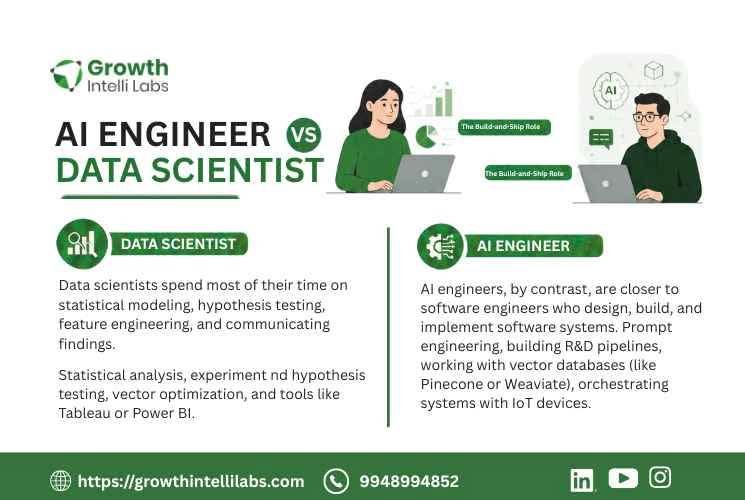
Data scientists spend most of their time on statistical modeling, hypothesis testing, feature engineering, and communicating findings to stakeholders. Their core toolkit is Python (pandas, NumPy, scikit-learn), SQL for data extraction, and visualization tools like Tableau or Power BI. Strong grounding in probability, experimental design, and causal inference remains central to this role – it what separates a data scientist from someone who simply runs machine learning libraries.
AI Engineer: The Build-and-Ship Role
AI engineers, by contrast, are closer to software engineers who specialize in AI systems. Their day-to-day work involves prompt engineering, building RAG pipelines, working with vector databases (like Pinecone or Weaviate), orchestrating agents with frameworks such as LangChain or LangGraph, and using MLOps practices – containerization with Docker, deployment on Kubernetes, CI/CD pipelines, and monitoring for model drift – to keep AI systems reliable in production. Deployment isn’t an afterthought for an AI engineer; it the core job.
If you are evaluating structured, mentor-led programs to build either skill set, GrowthIntelliLabs’ data science course in Hyderabad covers the statistics-and-modeling foundation, while its data analytics course in Hyderabad is a strong entry point if you’re starting from a business-analysis background and want to move toward either track.
AI Engineer vs Data Scientist: Skills and Responsibilities Compared
Both roles need Python and machine learning fundamentals, but the depth and direction of the skills diverge sharply once you move past the basics – data scientists go deeper into statistics and experimentation, AI engineers go deeper into software engineering and deployment. The table below breaks down where the two roles overlap and where they split.
| Aspect | Data Scientist | AI Engineer |
|---|---|---|
| Core focus | Extracting insights, building predictive models | Building and deploying AI-powered applications and agents |
| Typical question answered | “Why did sales drop?” “Which customers will churn?” | “How do we ship and scale a production chatbot/RAG system?” |
| Foundational skills | Statistics, probability, hypothesis testing, experimental design | Software engineering, REST APIs, authentication, system design |
| ML/AI skills | Regression, classification, clustering, feature engineering | LLM APIs, prompt engineering, RAG, agentic workflows, fine-tuning basics |
| Core tools | Python (pandas, NumPy, scikit-learn), SQL, Jupyter, Tableau/Power BI | Python/TypeScript, LangChain/LangGraph, LlamaIndex, vector databases, FastAPI |
| Deployment/MLOps | Usually hands off models to engineering teams | Owns deployment – Docker, Kubernetes, CI/CD, monitoring, drift detection |
| Primary output | Reports, dashboards, validated models, experiment results | Deployed, monitored applications and APIs used by end users |
| Team fit | Analytics, business intelligence, research/experimentation teams | Product and platform engineering teams |
| Indicative fresher salary (India) | ₹6–9 LPA | ₹6–15 LPA |
| Indicative mid-level salary (India) | ₹12–22 LPA | ₹15–30 LPA |
| Indicative senior salary (India) | ₹20–35 LPA | ₹30–60 LPA |
Where the Two Roles Overlap
Both roles need working Python skills, an understanding of how machine learning models are trained and evaluated, and enough statistical literacy to know when a model is actually good versus just appears good on paper. In smaller companies and startups, the same person may wear both hats – building a model and shipping it too. In larger organizations, the split is cleaner: data scientists sit closer to business and research teams, while AI engineers sit closer to product and platform engineering teams.
Where They Genuinely Diverge
The clearest divergence is in production ownership. A data scientist model can live happily in a notebook or a scheduled batch job. An AI engineer system has to survive real user traffic, unpredictable inputs, latency constraints, and cost limits – which is why concepts like cost-and-latency optimization for LLM calls, security for sensitive data, and agentic workflow design are now considered core AI engineering skills rather than “nice to have” extras.
AI Engineer vs Data Scientist Salary in India (2026)
Based on multiple 2026 India salary guides, AI engineers tend to command somewhat higher pay than data scientists at comparable experience levels, largely because production deployment and LLM/GenAI skills currently carry a premium – though both ranges vary widely by city, company, and specialization. Treat the figures below as indicative bands, not guarantees, since compensation surveys differ in methodology and sample size.
For data scientists in India, entry-level (0–1 year) pay is typically in the ₹6–9 LPA range, moving to roughly ₹12–22 LPA at the 4–6 year mark, and ₹20–35 LPA for senior professionals (7–10 years), with the reported national average sitting around ₹11–12 LPA. Professionals who add generative AI skills on top of a data science foundation are reported to earn noticeably more – some guides cite roughly 25–40% higher pay than generalist data scientists at the same experience level.
For AI engineers, freshers (0–2 years) are typically quoted around ₹6–15 LPA, mid-level professionals (2–5 years) around ₹15–30 LPA, and senior AI engineers (5–10 years) around ₹30–60 LPA, with leadership-track compensation (10+ years) reportedly reaching ₹50 LPA to ₹1 crore or more at top companies. Specialized sub-roles like NLP engineers and AI research scientists are reported to sit even higher, and skills in generative AI, LLMs, and MLOps are consistently flagged as the biggest differentiators for higher pay. City-wise, Bengaluru and Hyderabad are generally reported among the highest-paying hubs for AI roles in India, ahead of Pune and Chennai.
The consistent pattern across sources is directional rather than exact: production-facing, deployment-heavy AI roles are currently pricing at a premium over purely analytical data science roles, and that premium widens further up the seniority ladder. If your goal is to maximize near-term earning potential, layering AI engineering skills (LLM APIs, RAG, deployment) onto a data foundation is a reasonable strategy regardless of which title you eventually hold.
Why Generative AI Is Reshaping Both Roles
The short answer: generative AI has not replaced data science or created AI engineering as a side hustle – it has pulled deployment, LLM integration, and agentic system design into the mainstream, making them core hiring criteria for a large share of new AI-related openings in India. Multiple industry reports point to strong hiring momentum for GenAI-adjacent roles through 2026, even as exact growth figures vary by source and methodology.
Recent India hiring coverage has pointed to a large wave of new AI-related openings opening up within just a few months in 2026, with generative AI engineers (specializing in LLMs, often in FinTech), MLOps specialists (focused on automated deployment, notably in retail), and platform architects (building scalable AI infrastructure, notably in healthcare) named among the most sought-after profiles. Separately, industry hiring trackers have reported AI-linked job growth in the region of roughly 30% for 2026 – treat this as an indicative order of magnitude rather than a precise, universally agreed figure, since different trackers define “AI-linked roles” differently.
A recurring theme across these reports is that 3–5 years of experience is currently the sweet spot employers are hiring for – professionals who combine foundational data/ML knowledge with hands-on deployment experience. That’s a useful signal for anyone early in their career: pure theoretical knowledge is being valued less than demonstrated ability to ship and maintain real AI systems, which is exactly the AI engineering skill set.
For data scientists already in the workforce, this doesn’t mean the role is disappearing – statistics, experimentation, and business-facing analysis remain in demand, especially in sectors that are still building foundational data maturity. What it does mean is that data scientists who add even a working knowledge of LLM APIs, RAG, and basic MLOps are more competitive than pure generalists, because that combination shows up repeatedly in what employers are prioritizing.
Which Role Should You Target? A Decision Framework
If you enjoy digging into “why” a metric moved and are energized by statistics, experiments, and structured problem-solving, data science is likely the better fit; if you enjoy building things that ship, debugging production systems, and working close to software engineering, AI engineering is likely the better fit. Most people can succeed at either path with the right training – the decision is really about which day-to-day work you’d rather do.
Ask yourself these questions before committing to a track:
Do you prefer analysis or building?
Data scientists spend more time in notebooks, exploring data, running experiments, and communicating results. AI engineers spend more time writing production code, integrating APIs, and debugging deployed systems.
Are you comfortable with heavier statistics and math, or do you prefer systems thinking?
Data science leans harder on probability, hypothesis testing, and causal inference. AI engineering leans harder on system design, APIs, and infrastructure – statistics still matters, but less deeply than for a research-oriented data scientist.
Do you want to work close to business decisions, or close to the product?
Data scientists often sit near business, strategy, and research functions. AI engineers usually sit inside product and platform engineering teams shipping features.
What’s your existing background?
If you are coming from a software development background, AI engineering is often a shorter bridge. If you are coming from statistics, economics, or a research background, data science is typically the more natural starting point – with AI engineering skills layered on afterward.
Do you want maximum near-term flexibility?
If you are unsure, building a strong shared foundation – Python, SQL, core ML concepts, and basic exposure to LLM APIs – keeps both doors open. Many practitioners today move between the two roles over their career rather than staying locked into one forever.
There is no universally “better” choice – the two tracks pay well, are both in demand, and increasingly overlap. The right choice depends on which daily work you find more engaging and which existing skills you can leverage fastest.
How to Build the Right Skill Stack in Hyderabad
Wherever you land between the two tracks, the practical starting point is the same: solid Python, SQL, and statistics fundamentals, followed by track-specific specialization – deeper statistical modeling and business analytics for data science, or deeper software engineering, APIs, and MLOps for AI engineering. Hyderabad’s growing analytics, IT, and GCC ecosystem makes it a practical place to build and apply these skills locally.
A structured, project-based learning path – ideally with mentorship and real datasets rather than only recorded videos – tends to compress the learning curve considerably compared to self-study alone. For learners starting from a business or non-technical background, beginning with GrowthIntelliLabs’ data analytics course in Hyderabad builds the SQL, Excel, visualization, and statistical foundation that both data science and AI engineering are built on. From there, learners aiming at the deeper modeling and experimentation side of the field can progress into the data science course in Hyderabad, which covers machine learning, statistical modeling, and applied project work.
Regardless of which track you choose, prioritize hands-on portfolio projects over passive learning – a deployed mini-project (even a small RAG chatbot or a well-documented predictive model) demonstrates capability to employers far more effectively than certificates alone, particularly given how strongly current hiring trends favor demonstrated, practical experience over credentials.
Frequently Asked Questions
AI engineer vs data scientist – what is the main difference?
A data scientist mainly analyzes data and builds predictive models to answer business questions, while an AI engineer builds and deploys AI-powered applications such as chatbots, RAG systems, and agents that end users interact with directly. The data scientist’s core strength is statistics and experimentation; the AI engineer’s core strength is software engineering and production deployment.
Who earns more in India – AI engineers or data scientists?
Based on current India salary guides, AI engineers tend to earn somewhat more than data scientists at comparable experience levels, largely because LLM, GenAI, and MLOps deployment skills currently carry a market premium. That said, ranges overlap significantly and vary by city, company, and individual specialization, so these figures should be treated as indicative rather than fixed.
Do I need to know machine learning to become an AI engineer?
Yes, a working understanding of machine learning fundamentals is expected, but AI engineers do not need the same depth of statistical theory as a research-focused data scientist. What matters more for AI engineering is knowing how to integrate LLM APIs, build RAG pipelines, and deploy and monitor AI systems reliably in production.
Is data science becoming obsolete because of AI engineers?
No, data science is not becoming obsolete – the AI engineer role has emerged alongside data science to handle production deployment of AI systems, not to replace the analytical and experimentation work data scientists do. Many organizations still need both roles, and data scientists who add basic AI engineering skills are becoming more competitive rather than being displaced.
Which role has better job demand in India in 2026?
Both roles show strong demand in India in 2026, but multiple industry reports point to particularly fast growth in generative AI, MLOps, and platform-engineering-adjacent roles as companies move from experimenting with AI to deploying it in production. Data science demand remains steady, especially in analytics-heavy sectors, but the fastest-growing openings currently skew toward deployment and GenAI-integration skills.
Can a data scientist become an AI engineer?
Yes, this is a common and realistic career transition – data scientists already have the Python and machine learning foundation needed, and typically need to add software engineering practices, LLM/RAG tooling, and MLOps deployment skills to make the shift. Many professionals move between the two roles over the course of their careers rather than staying fixed in one track.
Should a beginner start with statistics, Python, or LLMs?
A beginner should start with Python and SQL fundamentals alongside core statistics, since both data science and AI engineering are built on that same base. Once those fundamentals are solid, you can specialize toward deeper statistical modeling for data science or toward APIs, deployment, and LLM tooling for AI engineering.
CTA
Deciding between AI engineer vs data scientist as your next move does not have to be a guessing game. At GrowthIntelliLabs, based in Kukatpally, Hyderabad, our data analytics, data science, and Gen AI training programs are built around hands-on projects, mentor guidance, and the practical skill stack employers are actually hiring for in 2026 – not just theory. Whether you’re starting from scratch or upskilling from a related field, our team can help you map the right learning path for your background and goals.
Call us at +91 9985199299 to talk to our career counselors about which track fits you best, or visit our Kukatpally, Hyderabad center to see our data analytics and data science programs in person.