

How Gen AI Is Changing the Data Analyst Job (And What to Learn Now)
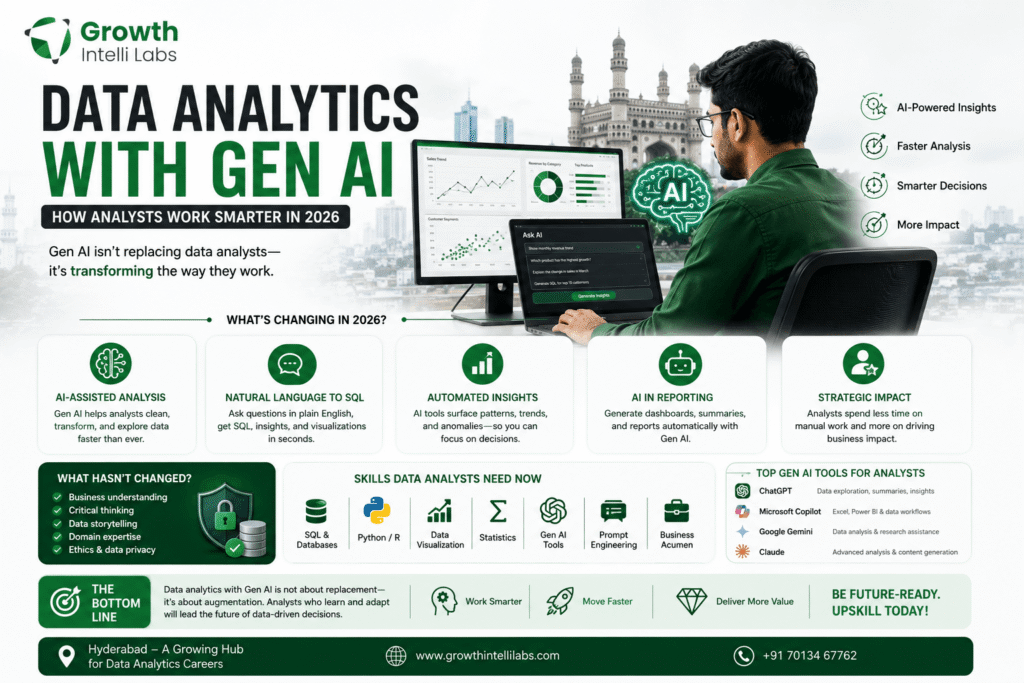
This is the shift anyone doing data analytics with gen AI tools needs to understand. Every few months, a headline claims AI is about to replace data analysts. The reality on the ground looks different: the job hasn’t gone away, but the parts of it that used to eat the most time – writing repetitive SQL, formatting the tenth version of the same report, building a first-draft dashboard – increasingly get done by AI tools in minutes. What’s left is the part that actually needed a human in the first place: judgment.
What is Actually Changed
- SQL drafting: analysts describe what they need in plain language and get a first-pass query back, then refine it – instead of writing every query from scratch.
- Report summarization: AI tools condense a long dataset or report into an executive-ready summary in seconds, cutting hours of manual write-up.
- First-pass dashboards: AI-assisted features in Power BI and similar tools suggest chart types and layouts based on the data, giving analysts a starting point instead of a blank canvas.
- Error explanation: When a formula or query breaks, AI tools explain the likely cause faster than searching forums, cutting debugging time.
What Has Not Changed – and Won Not
- Data validation: AI-generated output still needs a human to check whether the numbers actually make sense for the business.
- Business context: knowing which metric actually matters for a specific decision is judgment AI does not have.
- Stakeholder communication: explaining a finding to a skeptical manager in a meeting is still a human skill.
- Framing the right question: AI answers what you ask – deciding what’s actually worth asking is still the analyst’s job.
The New Skill Layer: Working With AI, Not Around It
This is not about becoming a prompt engineer. It’s about the same instinct experienced analysts have always needed toward a junior colleague’s work: check it, don’t just trust it. The analysts pulling ahead right now are the ones who use AI to move faster through the repetitive parts of the job, then spend the time they saved on the parts AI can’t do – validating the numbers, understanding the business question, and explaining the result clearly.
What to Actually Learn Now
| Skill | Why It Matters Now |
| Core SQL & Excel | Still the foundation – you can not validate AI-generated queries you do not understand |
| Power BI / Tableau | AI drafts the first pass; you still need to refine and own the final dashboard |
| AI-assisted workflows | Using ChatGPT/Copilot for SQL drafting, summarization, and debugging |
| Critical validation habits | Spotting when an AI-generated answer doesn’t actually match the data |
| Business communication | Translating findings into decisions – the part AI still can not do |
What This Means If You are Choosing a Course
A data analytics course that only teaches Excel, SQL, and Power BI without an explicit Gen AI layer is teaching last year’s job. GrowthIntelliLabs’ Data Analytics with Gen AI program builds AI-assisted workflows into the curriculum alongside the fundamentals – SQL, Power BI, Python, and how to use Gen AI tools without letting them replace your own judgment on the data.
For the full curriculum, see the Data Analytics Course in Hyderabad guide, or book a free demo class – call +91 9985199299.
Frequently Asked Questions
Is Gen AI replacing data analysts?
No. Gen AI automates repetitive parts of the job – drafting SQL, summarizing reports, suggesting charts – but it can not validate data accuracy, understand business context, or make the judgment calls a company relies on an analyst for. The role is shifting, not disappearing.
What Gen AI tools do data analysts actually use?
In practice: ChatGPT or Copilot for drafting SQL queries and explaining errors, AI features inside Power BI and Excel for first-pass dashboards and formula suggestions, and AI summarization tools for turning long reports into executive-ready summaries.
Do I need to learn prompt engineering to become a data analyst?
Not as a separate, formal skill – but you do need to get comfortable asking AI tools specific, well-scoped questions and critically checking their output, the same way you’d check a junior colleague’s work.
Will Gen AI lower data analyst salaries?
The opposite trend is more visible so far: analysts who combine core skills (SQL, Power BI) with AI-assisted workflows are more productive and increasingly preferred, which supports demand rather than eroding it. What’s shrinking is demand for analysts who only know manual, repetitive reporting.
Does a data analytics course in Hyderabad need to teach Gen AI tools?
Yes – a course that only teaches Excel, SQL, and Power BI without the Gen AI layer on top is teaching last year’s job. Look for a curriculum that explicitly includes AI-assisted workflows alongside the fundamentals.
CTA
Want to learn the AI-assisted analyst workflow from the start? Book a free demo class for GrowthIntelliLabs’ Data Analytics with Gen AI program – call +91 9985199299 or enroll online.