

Data Analyst vs Business Analyst: What’s the Real Difference?
What Is the Real Difference Between a Data Analyst and a Business Analyst?
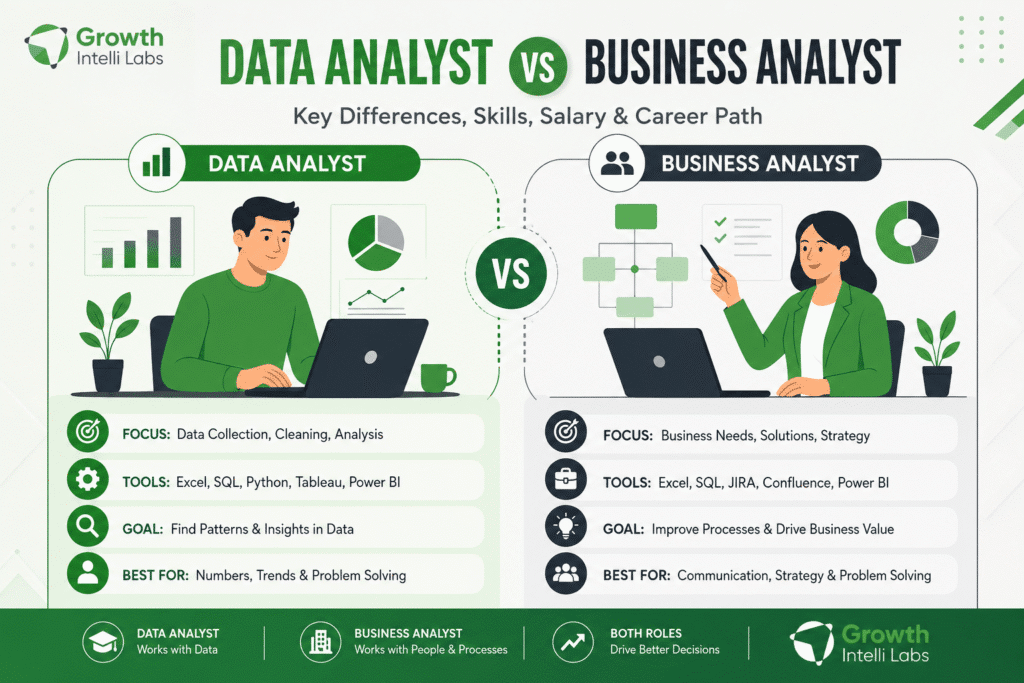
Weighing a data analyst vs business analyst career? The short answer: a data analyst works primarily with raw data – collecting, cleaning, querying, and visualizing it using SQL, Python, and BI tools – to answer “what happened and why.” A business analyst works primarily with people and processes – gathering requirements, mapping workflows, and translating business problems into solutions – to answer “what should we do about it.” Both roles feed decision-making, but one is data-first and the other is process-first.
The confusion is understandable because job titles in India are used loosely, and many companies – especially mid-sized IT services firms and startups in hubs like Hyderabad – blend both responsibilities into a single “Business/Data Analyst” posting. But when you look at what each role is actually accountable for, the split becomes clear: data analysts are measured on the accuracy and clarity of insights extracted from data; business analysts are measured on how well a proposed solution matches a real business need and gets adopted by stakeholders.
Understanding this distinction matters before you pick a training path, because the skill stack, the tools you’ll spend your day in, and the career ladder you climb are genuinely different – even though the two roles frequently sit next to each other on the same project team.
What Does a Data Analyst Actually Do Day-to-Day?
Direct answer: A data analyst day typically involves pulling and cleaning data with SQL, exploring patterns in Excel or Python, building dashboards in Tableau or Power BI, and presenting findings that support a specific business question – for example, “why did conversion drop in Q2?”
A typical data analyst’s week looks like this:
- Writing SQL queries against a data warehouse to extract the numbers a stakeholder needs
- Cleaning messy data (missing values, duplicate records, inconsistent formats) before any analysis can be trusted
- Using Python or R for statistical checks, cohort analysis, or forecasting when Excel isn’t enough
- Building and maintaining dashboards so business teams can self-serve metrics
- Running ad hoc analysis to answer a specific question from marketing, product, or finance
- Documenting definitions (what exactly counts as an “active user”?) so numbers stay consistent across the company
Data analysts are judged on rigor: is the SQL correct, is the sample size sound, is the chart telling the truth about the data. Communication matters, but it’s secondary to technical accuracy – a data analyst who presents a beautifully wrong number is a bigger liability than one whose slides are plain but the numbers are right.
What Does a Business Analyst Actually Do Day-to-Day?
Direct answer: A business analyst’s day is spent mostly in conversations and documentation – running stakeholder interviews, writing requirement documents (BRDs/FRDs), mapping current and future-state processes (often in BPMN via tools like Lucidchart or Visio), and working with product or IT teams to make sure a proposed system or process change actually solves the business problem.
A typical business analyst’s week looks like this:
- Interviewing stakeholders across departments to understand a pain point or opportunity
- Documenting “as-is” and “to-be” business processes, often as flowcharts
- Writing detailed requirement specifications for developers, vendors, or product managers
- Facilitating workshops and sign-off meetings to align stakeholders who often disagree
- Running UAT (user acceptance testing) to confirm a delivered solution matches what was asked for
- Tracking projects in tools like Jira or MS Project and reporting status to leadership
Business analysts are judged on translation quality: did they correctly capture what the business actually needs (not just what one loud stakeholder said), and did the eventual solution get adopted without a costly rework. Some technical fluency – enough SQL to pull a report, enough process-modeling notation to be precise – is increasingly expected, but deep coding or statistics is not the core job.
Skills and Responsibilities Comparison Table
Direct answer: Data analysts lean technical (SQL, Python, statistics, visualization); business analysts lean interpersonal and process-oriented (requirements gathering, stakeholder management, process mapping). The table below lines up the core differences side by side.
| Dimension | Data Analyst | Business Analyst |
|---|---|---|
| Core focus | Data – collection, cleaning, analysis, visualization | Business processes and requirements |
| Primary question answered | “What does the data show?” | “What does the business need?” |
| Core tools | SQL, Excel, Python/R, Tableau, Power BI | Excel, Jira, Lucidchart/Visio, Confluence, MS Office |
| Technical depth | High – querying databases, statistical methods, some ML exposure | Moderate — basic SQL/Excel helpful, not mandatory |
| Key deliverables | Dashboards, reports, statistical findings, data models | BRDs/FRDs, process maps, user stories, project documentation |
| Core soft skill | Analytical thinking, attention to detail | Communication, negotiation, stakeholder management |
| Typical background | STEM, statistics, computer science, engineering | Business administration, finance, commerce, MBA |
| Works most closely with | Data engineers, data scientists, BI teams | Product managers, IT teams, department heads, vendors |
| Success measured by | Accuracy and usefulness of insights | Adoption and fit of the delivered solution |
| Entry-level India salary (indicative) | Roughly ₹3.5–6 LPA | Roughly ₹4.5–6.5 LPA |
Note the overlap zone: mid-career professionals in both roles are increasingly expected to be comfortable with SQL and dashboards, which is why many analytics training programs – including ours – teach both the technical and the business-translation side together.
Data Analyst vs Business Analyst Salary in India (2026)
Direct answer: Indicative 2026 figures put average business analyst pay in India at roughly ₹9 lakh per year overall, with entry-level roles around ₹4.5–6.5 LPA. Data analyst pay in India follows a similar entry band (roughly ₹3.5–6 LPA for freshers) but can scale faster with strong Python/SQL/BI skills – senior data analysts at large tech firms have reported ₹20–35 LPA. In Hyderabad specifically, average data analyst pay has been reported around ₹6.6 LPA, with a typical range of about ₹3.2–13.6 LPA depending on experience and employer.
A few things worth flagging honestly:
- These are indicative ranges pulled from public salary-aggregator data (Indeed, EICTA/IIT Kanpur guide, and industry salary blogs) in 2026 – actual offers vary widely by company size, product vs services firm, and negotiation.
- Business analyst averages often look higher than data analyst averages at the aggregate level, but that’s partly because BA is a broader, more senior-skewed title bucket in many job boards; entry-level bands for both roles are actually fairly close.
- Specialized skills move the needle more than the job title does. A data analyst fluent in Python, SQL, and Power BI has been reported to command 25–35% more than a peer without those skills at the same experience level – and a business analyst who can read SQL and build a basic dashboard stands out from one who can’t.
- Treat every number here as a planning range, not a guarantee – always validate against current listings on Naukri, LinkedIn, Glassdoor, and Indeed for the specific city and industry you’re targeting before negotiating an offer.
Career Progression: Where Does Each Role Lead?
Direct answer: Data analysts typically progress from Junior/Data Analyst → Senior Data Analyst / BI Developer → Analytics Manager or Data Scientist, moving toward heavier statistics, machine learning, or team leadership. Business analysts typically progress from Junior BA → Business Analyst → Senior BA / Product Owner → Business Analysis Manager or Product Manager, moving toward strategy and stakeholder leadership.
Data analyst path:
- Junior Data Analyst – data cleaning, basic reporting, Excel/SQL
- Data Analyst / Senior Data Analyst – dashboarding, exploratory analysis, Python/R, some predictive work
- Senior Analyst / Analytics Lead – mentoring, defining metrics strategy, closer to machine learning
- Specialist tracks – Data Scientist, BI Manager, or domain specialist (marketing analytics, fintech analytics, healthcare analytics)
Business analyst path:
- Junior Business Analyst: requirement documentation, supporting senior analysts
- Business Analyst: process analysis, stakeholder facilitation, writing BRDs/FRDs
- Senior Business Analyst: leading complex projects, cross-functional alignment
- Specialist/leadership tracks: Product Owner, Product Manager, Business Analysis Manager, or domain BA (banking, healthcare, IT)
Both ladders offer comparable long-term upside; the difference is what you’re doing more of at each rung – data analysts go deeper into technical and statistical work, business analysts go deeper into strategy, negotiation, and cross-team leadership.
Which Role Suits Which Kind of Person?
The data analyst vs business analyst decision often comes down to fit, not skill level.
Direct answer: If you enjoy numbers, patterns, and building things in code, and you’d rather find the answer in a dataset than in a meeting, data analyst is the closer fit. If you enjoy talking to people, untangling ambiguous problems, and translating “what the business wants” into a clear plan, business analyst is the closer fit.
Ask yourself a few honest questions:
- Do you get energy from writing a SQL query until it returns the right number, or from running a workshop until a room full of stakeholders agrees on a plan?
- Would you rather learn Python and statistics, or process mapping and requirements documentation?
- Are you comfortable being the person who says “the data does not support that,” or are you better at finding the compromise that gets a project unstuck?
- Do you want your career to trend toward data science and machine learning, or toward product management and business strategy?
Neither answer is “better” – the market pays well for strong people in both roles, and the tools you will rely on (SQL, dashboards) increasingly overlap. What matters is picking the one that matches how you actually like to work, because that’s what determines whether you will put in the hours to get good at it.
Can You Switch Between the Two – or Do Both?
Direct answer: Yes – its common in India’s job market to move between data analyst and business analyst roles, especially in your first five years, because the two skill sets are complementary rather than opposed. Many professionals deliberately build a hybrid profile: strong enough in SQL and BI tools to be data-credible, and strong enough in stakeholder management to be business-credible.
This is exactly why a well-designed data analytics course in Hyderabad usually covers both the technical toolkit (SQL, Excel, Python, Power BI/Tableau) and the business-facing skills (requirement gathering, KPI definition, stakeholder communication) rather than teaching data analysis in a vacuum. If your longer-term goal leans toward machine learning, predictive modelling, or a Data Scientist title, it’s worth also looking at a structured data science course in Hyderabad that builds on analyst-level skills with statistics, ML, and deployment.
How to Choose the Right Course in Hyderabad
Direct answer: Choose a program based on the skills gap between where you are now and the job descriptions you’re targeting – not the job title alone. If most postings you want ask for SQL, Excel, Python, and a BI tool with real project work, prioritize a data-analytics-first program; if they ask for requirement documentation, process mapping, and stakeholder communication, prioritize a business-analysis-first program.
Practical checklist before enrolling anywhere in Hyderabad:
- Pull 10-15 real job postings for the title you want and list the tools/skills that repeat
- Check whether the curriculum includes hands-on projects with real or realistic datasets, not just slides
- Ask whether placement support and interview preparation are part of the program, not an afterthought
- Confirm the trainers have actual industry analytics/BA experience, not just teaching experience
- Compare course duration and fee against what you’re getting – tools covered, project count, mentor access, and career support
Frequently Asked Questions
Is a data analyst better than a business analyst, or is it more about fit?
In the data analyst vs business analyst comparison, neither role is objectively “better” – they solve different problems and suit different strengths. Data analysts are stronger in technical, quantitative work; business analysts are stronger in stakeholder-facing, process work, and average pay bands are broadly comparable at entry level in India.
Which pays more, data analyst or business analyst, in India?
It depends on level and skills more than title. Indicative 2026 data puts overall average business analyst pay around ₹9 LPA and data analyst entry pay around ₹3.5–6 LPA, but data analysts with strong Python/SQL/BI skills often scale faster into ₹14-22+ LPA senior brackets, so treat these as planning ranges rather than fixed rules.
Do I need to know coding for a business analyst role?
Not always mandatory, but it helps. Most business analyst roles do not require programming, but basic SQL and Excel proficiency is increasingly expected and makes you more competitive, especially in tech-driven companies.
Can a data analyst become a business analyst, or vice versa?
Yes, this transition is common. Because both roles share tools like SQL and Excel and both ultimately support business decisions, professionals frequently move between them or build hybrid skill sets within their first few years of work.
What qualifications do I need to become a data analyst or business analyst in Hyderabad?
A bachelor’s degree in any discipline is typically the baseline, followed by role-specific skill-building. For data analyst roles, that usually means SQL, Excel, Python/R, and a BI tool like Power BI or Tableau; for business analyst roles, it usually means requirement-gathering methods, process mapping, and business communication – either through a job, an MBA, or a focused certification course.
Which role is a better starting point if I’m not sure which I’ll enjoy?
Starting with data analytics fundamentals (SQL, Excel, dashboards) is a practical entry point because those skills are useful in both roles and let you decide, with real project experience, whether you enjoy the technical or the stakeholder-facing side more.
CTA
Still weighing data analyst vs business analyst as your next career move? That’s exactly the kind of decision that’s easier with guidance from people who’ve placed candidates into both kinds of roles. GrowthIntelliLabs, based in Kukatpally, Hyderabad, runs practical, project-based training in data analytics, data science, and Gen AI, with career guidance to help you map your existing background to the right role and course. Call +91 9985199299 to talk to our team about which track fits your goals, or explore our data analytics course in Hyderabad and data science course in Hyderabad pages for detailed curriculum information.