Building a Data Science Portfolio: 5 Projects That Actually Get Noticed (2026)
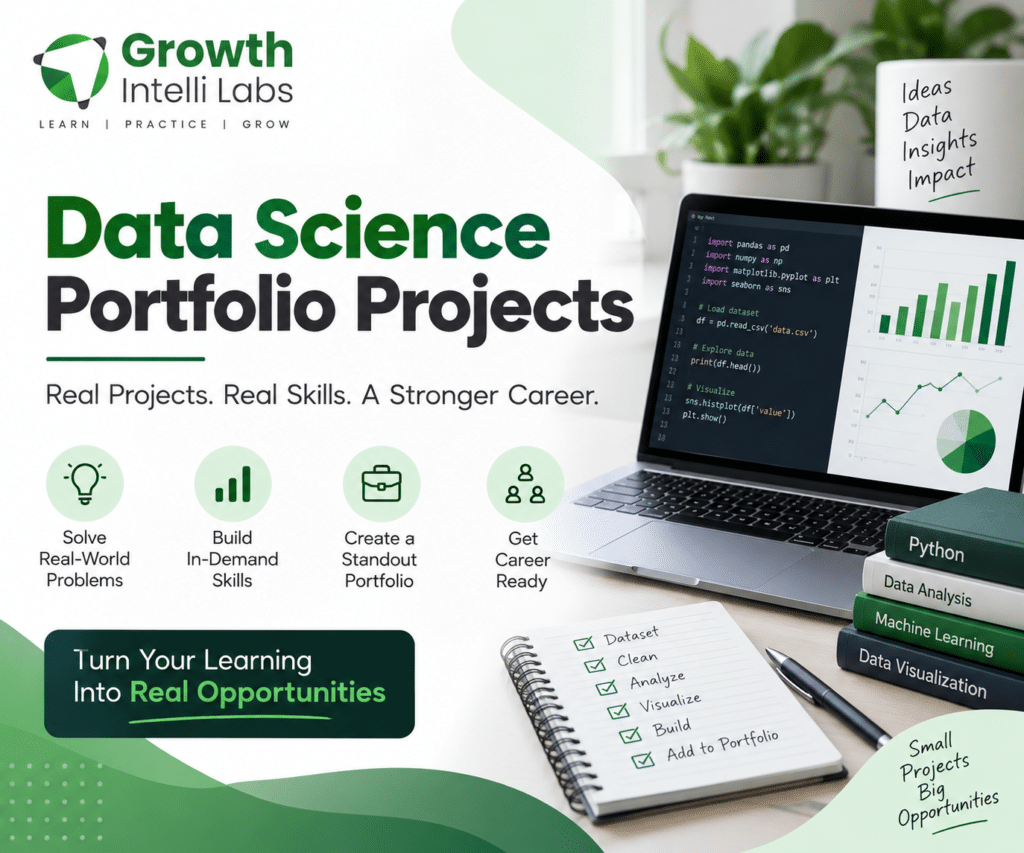
Building strong data science portfolio projects starts with knowing what separates a hire from a “no.” Hiring managers scan a portfolio for one thing first: proof you can carry a project from raw, messy data through a working model to a decision someone could act on – not proof that you can call .fit() on a dataset that has already been cleaned for you. Everything else – framework choice, notebook polish, leaderboard rank is secondary to that signal.
Demand backs this up. The U.S. Bureau of Labor Statistics projects 35% job growth for data scientists through 2032 among the fastest-growing occupations it tracks, well ahead of the 23% projected for data-analyst-adjacent roles. More openings also means more applicants competing for each one, and a portfolio is what gets you past the resume screen before an interview happens.
Quick Answers
- How many projects do I need? 3–5, fully documented. One deployed project beats five notebooks.
- Should I use Kaggle? Yes, just skip Titanic, Iris, MNIST, and Boston Housing. Pick something messier.
- Python or R? Python, for almost every role – it shows up in 57% of data scientist job postings vs R’s 33%. Learn R later if a specific job calls for it.
- Do I need to deploy a model? Not every project, but at least one its the single biggest portfolio differentiator.
What Hiring Managers Actually Look For in a Data Science Portfolio
Across recent hiring-focused guides, a few priorities repeat consistently:
- Real-world skills over toy exercises. Hiring managers want evidence you can operate across the full ML lifecycle – sourcing or cleaning data, engineering features, training and validating a model, and explaining what it means – not just evidence you followed a tutorial.
- Business framing over model complexity. The strongest portfolios lead with the business question (“Which customers are about to churn, and why?”) rather than the algorithm used to answer it. A 2-point lift in retention reads faster than a 0.02 improvement in AUC.
- Honest evaluation, not just a high score. Recruiters want to see a proper train/validation/test split, a baseline model to compare against, and an honest discussion of where the model fails – not a leaderboard-style accuracy number with no context.
- Communication for non-technical audiences. Since much of the job is explaining model behavior to stakeholders who don’t read confusion matrices, portfolios that include a plain-language summary alongside the technical notebook stand out.
- Public validation. Projects that are shared, discussed, or usable by someone else – a starred GitHub repo, a live demo people can actually try, an upvoted Kaggle notebook – signal the work holds up outside your own judgment.
- Depth over breadth. One properly documented, deployed project consistently beats five abandoned notebooks with no README.
If you are still building the foundational skills these projects require – Python, statistics, machine learning, and at least one deep learning framework – a structured program like GrowthIntelliLabs’ Data Science with Gen AI course in Hyderabad can shorten the path from “learning the tools” to “having something worth showing.”
Why Titanic, Iris, and MNIST Hurt More Than They Help
Titanic survival prediction, Iris classification, MNIST digit recognition, and the (now-deprecated) Boston Housing price dataset are the most over-submitted portfolio projects in data science, and hiring managers recognize them instantly – which means they signal “followed a tutorial” rather than “solved a problem.” The same applies to an unmodified Kaggle competition notebook unless you placed competitively.
These datasets are clean, small, and pre-labeled, which is exactly why they were built for teaching – not for demonstrating job-ready skill. A hiring manager reviewing dozens of portfolios a week has seen the same 97%-accuracy digit classifier too many times to be impressed by it. The dataset isn’t the problem; the absence of an original business question, original feature engineering, or original judgment about what the model gets wrong is.
The fix is not avoiding public datasets altogether – it’s choosing ones that are messy, current, or under-used, and pairing them with a business question you define yourself and a model you can honestly explain, rather than a pre-set competition target.
5 Data Science Portfolio Projects That Actually Get Noticed
The five project types below cover the skill areas hiring managers screen for – supervised modeling, unstructured text, time-aware forecasting, shipping a model beyond a notebook, and end-to-end storytelling – so together they demonstrate range, not repetition of one skill.
Pick projects from different categories rather than five variations of the same skill. A portfolio with one tabular model, one NLP project, one forecasting project, one deployed demo, and one end-to-end case study maps directly onto what a hiring manager actually needs done.
1. A Real-World Classification or Regression Model
What it demonstrates: A proper modeling workflow, not a notebook demo – feature engineering, a train/validation/test split that avoids leakage, a simple baseline you beat before reaching for anything fancy, and an honest look at where the model is wrong.
A good starting dataset is Telco Customer Churn on Kaggle: a real business problem, mixed data types, and enough messiness to require actual cleaning decisions. Start with logistic regression as your baseline, then try a gradient-boosted model (XGBoost or LightGBM) and report whether the lift was worth the added complexity – that comparison is more impressive than the final number alone.
Tools to use: Python (pandas, scikit-learn), Jupyter Notebook, XGBoost or LightGBM for the stronger model, and a short written note on which features mattered and why.
2. A Natural Language Processing Project
What it demonstrates: Text is the most common unstructured data type analysts and scientists run into outside the classroom, so this project proves you can go beyond tabular data – tokenization, embeddings, and choosing a model that fits the problem size.
Pull a dataset from Hugging Face’s dataset hub – the IMDb reviews dataset is a well-worn but solid starting point for sentiment classification, or scrape your own reviews/comments for something more original. Start with a simple TF-IDF plus logistic regression baseline before reaching for a fine-tuned transformer – knowing when the simple approach is “good enough” is itself a signal of judgment. If you want to show Gen AI fluency specifically, add a small step using an LLM API to label or summarize a sample and compare it against your trained model output.
Tools to use: Python (scikit-learn for the baseline; Hugging Face transformers if you fine-tune), a confusion matrix or per-class breakdown, not just overall accuracy.
3. A Time-Series Forecasting Project
What it demonstrates: Forecasting is a different discipline from standard classification – your train/test split has to respect time order (no random shuffling), and you are evaluated on how wrong you are, not just whether you are right or wrong.
Good source options for India-relevant series include data.gov.in and the RBI for inflation, trade, or sectoral output data. Forecast something with a clear stakeholder use – next quarter demand, expected footfall, or a price index – and show your forecast against what actually happened, not just against your own backtest.
Tools to use: Python (statsmodels or Prophet for a classical baseline, XGBoost with lagged features for a stronger model), and a chart showing forecast vs. actual with a confidence band.
4. A Deployed Model – Not Just a Notebook
What it demonstrates: This is the single biggest gap between an average and a strong data science portfolio. Most candidates stop at a Jupyter notebook; a working demo a recruiter can click and try proves you understand the last mile of shipping a model, not just training one.
Take the model from project 1 or 2 and put a simple interface on it – Streamlit or Gradio for the front end, hosted for free on Hugging Face Spaces. If you want to go further, wrap it in a small FastAPI service so the model is callable as an API, not just clickable in a browser – that’s a closer match to how models actually run in production.
Tools to use: Streamlit or Gradio, Hugging Face Spaces (or Render/Railway for an API), and a short note on latency or limitations – what happens with input the model has never seen.
5. An End-to-End Case Study (Business Question to Model to Recommendation)
What it demonstrates: This is your capstone – the project that proves you can carry a vague business question all the way to a model-backed recommendation without hand-holding. It’s the project a hiring manager is most likely to read in full, so it should be your best-documented piece of work.
Pick a business question with real stakes: “Which customers should we target for a retention campaign, and what would it be worth?” or “Which product listings are likely to get returned, and why?” Walk through the full pipeline – raw data, cleaning, feature engineering, model selection with a baseline comparison, evaluation on a proper holdout set, and a written recommendation with the trade-offs and error cases stated. Gen AI–assisted analysis – using an LLM to draft the first pass of a written summary from your model outputs, then editing it yourself – is a legitimate, differentiating step if you’ve gone through GrowthIntelliLabs’ Data Science with Gen AI track.
Tools to use: Python for the pipeline, scikit-learn or XGBoost for the model, and a written case-study document that narrates the project the way you’d explain it in an interview.
Want Guidance Instead of Guessing?
Building one of these from scratch is where most people stall – not from lack of skill, but from not knowing which dataset, which baseline, or which deployment tool to start with. GrowthIntelliLabs’ Data Science with Gen AI program pairs each project type with instructor feedback on real datasets, so your first portfolio piece doesn’t take three false starts to get right. See the Data Science course →
Which Language and Tools to Build and Show Your Work On
In a 2025 review of over 1,000 data science job postings, Python appeared in 57% of listings versus 33% for R – a wide enough gap that Python should be your default unless a specific role (academic research, biostatistics, pharma) calls for R. The same review found machine learning skills in 69% of postings and NLP in 19%, up sharply from the year before.
- GitHub / GitHub Pages: Your code, notebooks, and README live here. This is where technical reviewers verify your actual work and commit history, not just a finished chart.
- Hugging Face Spaces: Best for a free, clickable demo of a deployed model – the fastest way to show project 4 without managing your own server.
- Kaggle: Useful for exploratory work and competition credibility if you rank well – a generic, low-ranking submission adds little on its own.
- R: Keep it in your back pocket rather than leading with it, unless you are specifically targeting academic, biostatistics, or pharma-adjacent roles.
If dashboards and business-facing BI work sound closer to what you actually want to do day to day, it may be worth comparing against the analyst track – see our data analyst portfolio projects guide for that version of this same advice.
How to Present a Project So Recruiters Actually Read It
A project only counts if a hiring manager can understand what it does, why it matters, and how well it actually works within about 90 seconds of opening it – which means presentation and honest evaluation matter almost as much as the modeling itself.
Use this checklist for every project before you consider it “portfolio-ready”:
- Business question stated first: the README opens with the question, not the dataset or the algorithm
- Context on the data source: where it came from, its size, and its time range
- A stated baseline: what simple model or rule you compared against, not just the final score
- Honest evaluation: the metric you optimized for, why, and at least one example of where the model is wrong
- Methodology explained in plain language: a non-technical reader can follow your approach without reading the code
- A specific, actionable recommendation: not just “the model works,” but what a stakeholder should do with it
- A live demo link when possible: not just a static notebook, especially for project 4
- Clean, well-organized repository: consistent file naming, a requirements file, and no stray scratch files
- A short summary at the top: 2–3 sentences anyone (technical or not) can read before deciding to dig deeper
- Proof it’s current: a last-updated date, especially for anything using live or frequently-refreshed data
README / Model Card Template – Copy and Fill In
Use this as the starting file for every project. Delete the brackets, keep the structure.
# [Project Title]

## Business Question
[One sentence - what does this answer?]

## Summary
[2–3 sentences, readable before deciding to dig deeper]

## Data Source
- Source:
- Size / time range:
- Access date:

## Cleaning & Feature Engineering
- Dropped:
- Missing values handled:
- Key features created:

## Model
- Baseline:
- Final model:
- Key metric (and why):
- Where it gets it wrong:

## Recommendation
[Specific - not just "the model works"]

## Tools Used

## Live Demo / Notebook Link
Nothing makes this concrete faster than seeing it done well. GrowthIntelliLabs students have taken projects like these into real interviews – see current placement outcomes on our Placements page, or ask your program counselor for portfolio examples from recent graduates.
Frequently Asked Questions
What are the best data science portfolio projects for beginners?
The best data science portfolio projects for beginners are ones built on a real, moderately messy dataset with a defined business question – a classification or regression model with a clear baseline is the strongest starting point because it teaches the full workflow (cleaning, features, evaluation) without the added complexity of deployment or unstructured data.
How many projects should be in a data science portfolio?
Three to five fully documented projects is the range most hiring guides recommend, with at least one deployed beyond a notebook – depth and honest evaluation matter more to hiring managers than the raw number of repositories in your GitHub profile.
Should I use Python or R for my portfolio?
Python, for almost every data science role – it appears in roughly 57% of postings, compared with 33% for R. R is still the stronger choice if you are specifically targeting academic research, biostatistics, or pharmaceutical analytics.
Do I need to deploy a model, or is a notebook enough?
A notebook is enough for most of your projects, but at least one deployed, clickable demo – even a simple Streamlit app on Hugging Face Spaces – is the single clearest way to stand out, since most competing portfolios stop at a notebook.
How do I write a good README for a data science project?
A good README opens with the business question and a summary, explains the data source and feature engineering, states your baseline and final model with an honest evaluation of where it fails, and ends with a specific recommendation – structured so a non-technical reader understands the project without opening any code.
Can I get a data science job with only portfolio projects and no prior experience?
A strong portfolio of 3–5 well-documented, honestly evaluated projects – including at least one deployed model – can meaningfully improve your chances as a fresher, but it typically works best alongside structured training in statistics, Python, and machine learning fundamentals. Results always vary by market, role, and individual effort, and no portfolio guarantees a specific outcome.
Where can I find real datasets for these projects?
Kaggle (Telco Customer Churn is a solid starting point) works well for tabular classification, Hugging Face’s dataset hub is the easiest way into NLP, and government portals like data.gov.in and the RBI work well for India-relevant time-series forecasting.
Ready to Turn These Projects Into an Interview-Ready Portfolio?
If you are in Hyderabad and want structured guidance on turning these data science portfolio projects into an actual, interview-ready portfolio, GrowthIntelliLabs offers hands-on Data Science with Gen AI training out of its Kukatpally center, with instructor support on real-world datasets, model deployment, and project documentation. Explore the Data Science course – or, if BI and dashboards fit your goals better than modeling, the Data Analytics course – or call +91 9985199299 to talk through which track fits your background and career goals. Figures and timelines discussed during counseling are indicative and depend on individual effort, prior background, and the job market at the time.